If you've ever sat at a standard blackjack table and wished you could see what the dealer is holding, Double Exposure Blackjack is the game you've been waiting for. Available at pkjl, this fascinating variant flips one of the most fundamental rules of traditional blackjack on its head — both of the dealer's cards are dealt face-up from the very start of each hand. No hidden hole card, no guessing, no uncertainty about what you're up against. You see everything, and you make your decisions with full information.
It sounds like an enormous advantage for the player, and in some ways it is. But the game designers were smart about it — Double Exposure Blackjack comes with a set of rule adjustments that restore the house edge to a reasonable level while keeping the game genuinely exciting and strategically rich. Understanding those rule differences is the key to playing well, and pkjl makes it easy to learn and practice before you commit real pesos to the table.

What Makes Double Exposure Blackjack Different?
The core rule changes you need to know before you play
The defining feature — both dealer cards face-up — is just the beginning. To compensate for this massive information advantage given to the player, the game introduces several rule modifications that shift the balance back toward the house. Here's what changes at the pkjl Double Exposure Blackjack table compared to standard blackjack:
The dealer's entire hand is visible from the deal. You know exactly what total you're competing against before making any decision.
This is the biggest compensating rule. In standard blackjack, a tie (push) returns your bet. In Double Exposure, the dealer wins all ties — except a tied natural blackjack, which is a push.
A natural blackjack (Ace + 10-value card) pays 1:1 instead of the standard 3:2. This is a significant reduction in the player's expected value from naturals.
Since both dealer cards are visible, the insurance side bet (which protects against dealer blackjack) is not offered — it would be a guaranteed win whenever the dealer shows Ace + 10.
At pkjl's Double Exposure tables, doubling down is typically restricted to hard totals of 9, 10, or 11 only. You cannot double on soft hands or other hard totals.
Pairs can be split, but re-splitting is generally not allowed. Aces can be split but you receive only one additional card per Ace — and a 10-value card on a split Ace counts as 21, not blackjack.
How to Play Double Exposure Blackjack at pkjl
Step-by-step guide for beginners and returning players
Getting started with Double Exposure Blackjack at pkjl is straightforward, whether you're a first-timer from Quezon City trying online blackjack for the first time or a seasoned card player from Cebu who's been playing standard blackjack for years. Here's how a typical hand plays out:
Select your chip value and click the betting area to place your wager. Minimum bet at pkjl starts at ₱100. You can fund your account via GCash, Maya, or any major Philippine bank.
You receive two cards face-up. The dealer also receives two cards — both face-up. This is the moment that makes Double Exposure unique: you immediately see the dealer's full hand total.
If the dealer has a natural blackjack (21 with two cards), the round ends immediately. If you also have blackjack, it's a push. Otherwise, the dealer wins. This happens before you take any action.
With full knowledge of the dealer's hand, choose to Hit (take another card), Stand (keep your current total), Double Down (on hard 9/10/11 only), or Split (if you have a pair). Your strategy should be adjusted specifically for Double Exposure rules.
The dealer draws to a set of fixed rules — typically hitting on soft 17. Since you already know the dealer's starting total, you can anticipate exactly what totals the dealer might reach.
If your total beats the dealer without busting, you win even money on your bet. Remember: ties go to the dealer (except tied blackjacks). Blackjack pays 1:1 at pkjl's Double Exposure tables.
Basic Strategy for Double Exposure Blackjack
Adjusted strategy for the unique rules of this variant
Standard blackjack basic strategy does not apply directly to Double Exposure Blackjack. Because you can see both dealer cards and because ties lose, the optimal strategy shifts significantly. The general principles are: be more aggressive when the dealer is weak, stand more often when the dealer is strong (since ties lose, you need to beat the dealer's total, not just match it), and double down more aggressively on 10 and 11 when the dealer shows a weak total.
Here's a simplified strategy reference for common situations at the pkjl Double Exposure Blackjack table:
| Your Hand | Dealer Shows ≤ 13 | Dealer Shows 14–16 | Dealer Shows 17–18 | Dealer Shows 19–20 |
|---|---|---|---|---|
| Hard 8 or less | Hit | Hit | Hit | Hit |
| Hard 9 | Double | Hit | Hit | Hit |
| Hard 10 | Double | Double | Hit | Hit |
| Hard 11 | Double | Double | Double | Hit |
| Hard 12–16 | Hit | Stand | Hit | Hit |
| Hard 17–20 | Stand | Stand | Stand | Hit / Stand* |
| Pair of Aces | Split | Split | Split | Split |
| Pair of 8s | Split | Split | Hit | Hit |
* Stand on 17–20 vs dealer 19–20 only when your total exceeds the dealer's. Hit when tied (ties lose). This table is a simplified guide — full optimal strategy charts are available in the pkjl help section.
Since ties go to the dealer, if your total equals the dealer's total, always hit (unless you'd bust). A tie is a loss, so you must try to beat the dealer's exact total.
Double down on 10 and 11 more often than in standard blackjack. Knowing the dealer's total lets you calculate exactly how much you need — use that information to maximize your doubles.
In standard blackjack you often stand on 12–16 vs a weak dealer. In Double Exposure, standing on a stiff hand when the dealer shows a strong total is usually wrong — you need to beat them, not hope they bust.
Why Filipino Players Love Double Exposure Blackjack at pkjl
More than just a card game — it's a thinking player's experience
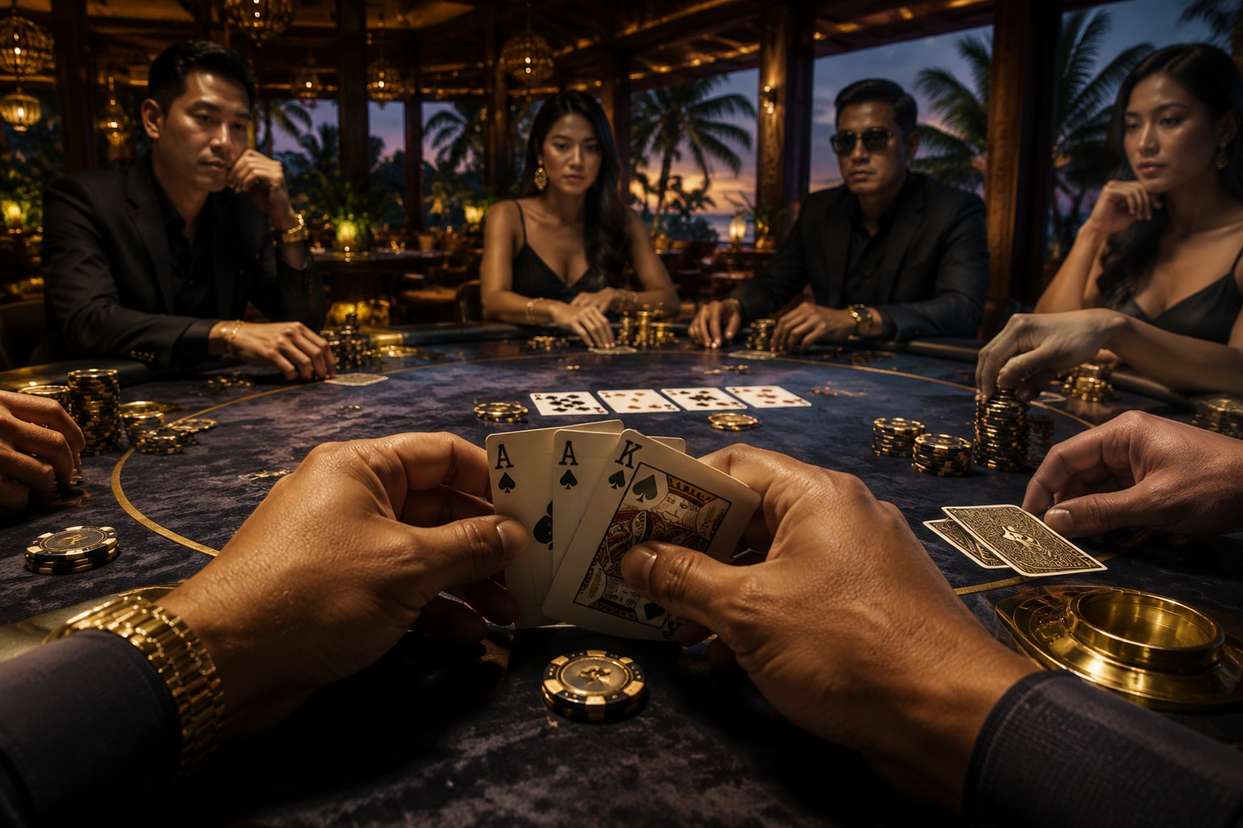
There's something deeply satisfying about playing a card game where you have complete information. Filipino players — who are known for being sharp, strategic, and highly competitive whether they're watching PBA playoffs or playing pusoy dos with family — tend to gravitate toward Double Exposure Blackjack once they discover it. The game rewards careful thinking and punishes passive play, which makes every session feel genuinely engaging rather than purely luck-based.
At pkjl, the Double Exposure Blackjack tables are available around the clock, so whether you're playing during your lunch break in Makati, unwinding after a long day in Davao, or enjoying a late-night session from your condo in BGC, the table is always open. The interface is clean and mobile-optimized, loading quickly even on standard Philippine mobile data connections. Deposits via GCash or Maya take seconds, and withdrawals are processed back to your e-wallet or bank account with no unnecessary delays.
pkjl also offers a practice mode for Double Exposure Blackjack, which is genuinely useful for this variant. Because the strategy differs so significantly from standard blackjack, spending time in practice mode before playing for real pesos is one of the smartest things a new player can do. Get comfortable with the tie-loss rule, practice your doubling decisions, and build confidence before stepping up to the real-money tables.
Double Exposure vs Standard Blackjack
A quick comparison to help you choose the right game
| Feature | Standard Blackjack | Double Exposure (pkjl) |
|---|---|---|
| Dealer cards visible | 1 face-up, 1 face-down | Both face-up |
| Ties (push) | Player gets bet back | Dealer wins (except BJ tie) |
| Blackjack payout | 3:2 | 1:1 (even money) |
| Insurance | Available | Not available |
| Double down | Any two cards | Hard 9, 10, 11 only |
| Strategy complexity | Moderate | Higher (unique adjustments) |
| House edge (optimal play) | ~0.5% | ~0.69% |
Frequently Asked Questions
Common questions from pkjl players about Double Exposure Blackjack
Is Double Exposure Blackjack available on mobile at pkjl?
Yes. pkjl's Double Exposure Blackjack is fully optimized for mobile browsers on both Android and iOS. No app download is required — just open pkjl in your mobile browser and the game loads smoothly even on standard Philippine mobile data.
Can I use GCash to fund my pkjl account for blackjack?
Absolutely. GCash and Maya are among the most popular deposit methods at pkjl. Deposits are credited instantly, and you can start playing Double Exposure Blackjack within minutes of funding your account.
Why does the dealer win on ties in Double Exposure Blackjack?
This rule compensates for the massive advantage players receive from seeing both dealer cards. Without it, the player advantage would be too large for the game to be commercially viable. It's the primary mechanism that keeps the house edge at a reasonable level.
Is there a practice mode at pkjl for Double Exposure Blackjack?
Yes. pkjl offers a demo/practice mode that lets you play with virtual chips at no cost. This is highly recommended for Double Exposure Blackjack specifically, since the strategy differs significantly from standard blackjack and takes some time to internalize.
Is pkjl licensed and legal for Filipino players?
pkjl operates within the PAGCOR regulatory framework that governs online gaming in the Philippines. Players must be 21 years of age or older to participate in any real-money gaming activity on the platform.